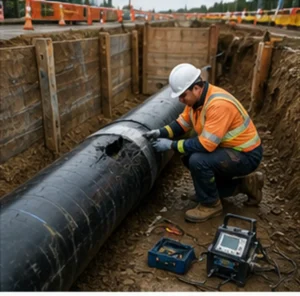
If you have ever seen a construction crew working on a busy street in Vancouver or Langley, you probably expected to see massive trenches and blocked-off traffic. For a long time, the only way to fix a pipe was to dig a giant hole. But lately, more projects are happening deep underground without anyone ever digging a single long ditch.
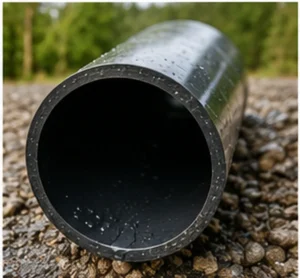
This modern method is called trenchless technology. Specifically, it is known as Horizontal Directional Drilling (HDD). At the heart of this “no-dig” revolution is a special material that is changing the way we build our cities: High-Density Polyethylene (HDPE) pipe.
In this guide, we will look at why HDPE is the number one choice for trenchless projects. We will also explore why engineers across Canada are moving away from old materials and making the switch to custom HDPE fabrication.
What is Horizontal Directional Drilling (HDD)?
Before we talk about the pipe itself, let’s talk about how the work gets done. Horizontal Directional Drilling is a clever way to install HDPE pipe underground by drilling a path sideways rather than digging from the top down.
The process usually follows three main steps:
- The Pilot Hole: A drill bit creates a small path deep underground, guided by a computer to stay on the right track.
- The Reaming: The hole is widened by a larger tool until it is the correct size for the new pipe.
- The Pull-Back: The new pipe is attached to the drill and pulled all the way through that underground tunnel.
Because the pipe is being dragged through rocks, heavy dirt, and thick mud, it needs to be incredibly tough. This is exactly where the advantages of HDPE become clear.

Why HDPE is the King of Trenchless Technology
1. Incredible Flexibility and “Bend Radius”
Traditional pipes made of concrete or PVC are very stiff. If you try to bend them, they will snap or crack. In HDD projects, the drill path is rarely a perfectly straight line. The drill often has to curve under rivers, go around highways, or dip below existing buildings.
HDPE is naturally flexible. It can follow the curved path of a drilled hole without breaking. This “bend radius” allows engineers to steer around obstacles that would stop other materials in their tracks. When comparing PVC vs. HDPE pipe, the ability to bend is one of the biggest reasons why HDD experts choose HDPE.
2. High Strength for the “Pull-Back.”
During the installation, a powerful machine literally pulls hundreds of feet of pipe through the ground. This creates a massive amount of force, almost like a giant game of tug-of-war.
If you used a pipe with weak joints, the pipe would pull apart halfway through the project. However, the process of HDPE pipe welding creates a joint that is actually stronger than the pipe itself. Because the joints are melted together at a molecular level, the entire line becomes one long, continuous, leak-proof string. This is much better than the “bell and spigot” joints found in PVC pipes used for water supply, which can easily slide apart under pressure.
3. Resistance to Shifting Ground
The ground is always moving. In Canada, the cycle of freezing and thawing causes the earth to expand and shrink constantly. HDPE has a high resistance to “fatigue,” which means it can handle stress over and over again. It can expand and contract or handle sudden changes in water speed without becoming brittle. While other materials might shatter under these stresses, HDPE absorbs the energy and stays in one piece.

The Environmental and Cost Benefits for Canadians
Trenchless technology isn’t just a cool way to use machines—it is actually much better for our environment and our wallets. By using HDPE and HDD together, we see several benefits:
- We Save Trees: We don’t have to clear-cut a long path through a park or forest to lay a pipe.
- Traffic Keeps Moving: Roads stay open to cars and buses because the work is happening 20 feet below the asphalt.
- A Greener Choice: HDPE has a very low environmental impact because it doesn’t leak chemicals into the soil and lasts for up to 100 years.
- Lower Repair Costs: Since we aren’t digging a massive trench, the city doesn’t have to pay to repave miles of road once the job is done.
Why WGS Plastic Services is the Expert You Need
Installing HDPE through drilling isn’t as simple as just “pulling a rope.” It requires a very precise process called thermal fusion. If the fusion isn’t done correctly, the pipe could fail underground. That would lead to a massive and expensive repair.
At WGS Plastic Services, we bring over 30 years of experience to the job site. We understand the specific HDPE pipe dimensions and SDR (Standard Dimension Ratio) requirements needed to withstand the forces of the “pull-back.” Whether it’s a city water line or an industrial pipe, we make sure every weld is perfect.
Key Factors We Consider for HDD:
- SDR Rating: We help you choose the right wall thickness so the pipe doesn’t collapse under the weight of the earth. You can learn more about how we measure this by understanding what outside diameter means.
- Fusion Cooling Times: We ensure the joints are fully cooled and strong before the machine starts pulling.
- Weather Control: We are experts at managing cold weather HDPE fusion to ensure a perfect bond, even in the middle of a Canadian winter.
Final Thoughts
Trenchless technology is the future of Canadian infrastructure, and HDPE is the engine driving it. Its mix of flexibility, strength, and leak-proof joints makes it the only logical choice for Horizontal Directional Drilling.Are you planning a municipal or industrial piping project? Don’t leave your fusion to chance. Contact WGS Plastic Services today to discuss how our expert HDPE fusion and fabrication services can make your next trenchless project a success.