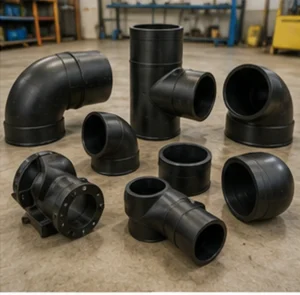
HDPE pipe fittings connect pipe sections, change flow direction, create branches, reduce pipe size, and connect HDPE systems to valves or equipment. Common fittings include elbows, tees, reducers, couplings, flange adapters, branch saddles, end caps, and custom fabricated fittings. Each fitting has a specific job within the piping system.
Choosing the right fitting takes more than matching pipe diameter. You also need to consider pressure, DR or SDR, material, joining method, temperature, site conditions, and what the pipe carries. This guide explains the main HDPE fitting types, where they are used, and how to select the right option for a project.
Quick answer: Common HDPE pipe fittings include elbows, tees, reducers, couplings, flange adapters, branch saddles, and end caps. Choose a fitting based on pipe size, DR or SDR, pressure, material compatibility, joining method, temperature, and application. Molded fittings suit many standard layouts, while fabricated fittings are useful for large pipe, unusual angles, and custom systems.
What Is an HDPE Pipe Fitting?
An HDPE fitting is a component used to connect or change a high-density polyethylene piping system.
A fitting may:
- Connect two pipe sections
- Change direction
- Create a branch
- Change pipe size
- Close a pipe end
- Connect pipe to a pump or valve
- Join HDPE to another material
- Create a custom piping layout
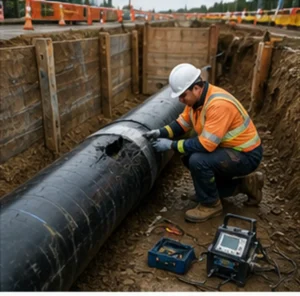
Many HDPE fittings can be joined using heat fusion. For professional joining work, see HDPE fusion services.
Main Types of HDPE Pipe Fittings
| Fitting | Main use |
| Elbow | Changes pipe direction |
| Tee | Creates a branch |
| Reducer | Changes pipe size |
| Coupling | Connects pipe sections |
| End cap | Closes a pipe end |
| Flange adapter | Connects to valves or equipment |
| Branch saddle | Adds a branch |
| Wye | Creates an angled branch |
| Custom fitting | Handles unusual layouts |
HDPE fittings may also be described as molded, fabricated, electrofusion, or mechanical fittings.
HDPE Elbows
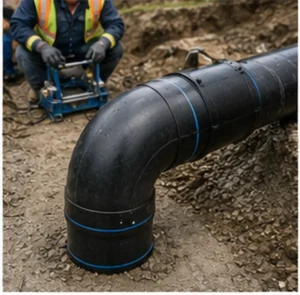
An elbow changes pipeline direction.
Common angles include:
- 90 degrees
- 45 degrees
- Custom angles
Elbows are useful when pipe must turn around equipment, follow a trench, or enter a structure from a different direction.
Standard elbows may be molded. Large-diameter or unusual angles may require custom HDPE fabrication.
HDPE Tees
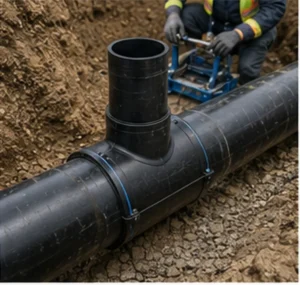
A tee creates a branch from the main pipeline.
An equal tee uses the same nominal size through all three connections.
A reducing tee connects a smaller branch to a larger main line.
Tees are common in:
- Water systems
- Industrial piping
- Process lines
- Distribution networks
The pipe size, pressure, and joining method should be checked before selecting a tee.
HDPE Reducers
A reducer connects two different pipe sizes.
For example:
12-inch HDPE → reducer → 8-inch HDPE
Reducers are used when flow requirements, equipment, or system design require a size change.
Common types include:
- Concentric reducers
- Eccentric reducers
A reducer should match the pipe size, DR or SDR, pressure, material, and joining method.
See the HDPE pipe dimensions guide for more information about pipe measurements.
HDPE Couplings
A coupling connects two pipe sections.
Common options include:
- Electrofusion couplings
- Mechanical couplings
- Transition couplings
A straight butt-fusion joint may not need a separate coupling because compatible pipe ends can be fused directly together.
Couplings are often useful where pipe movement is limited or another joining method is needed.
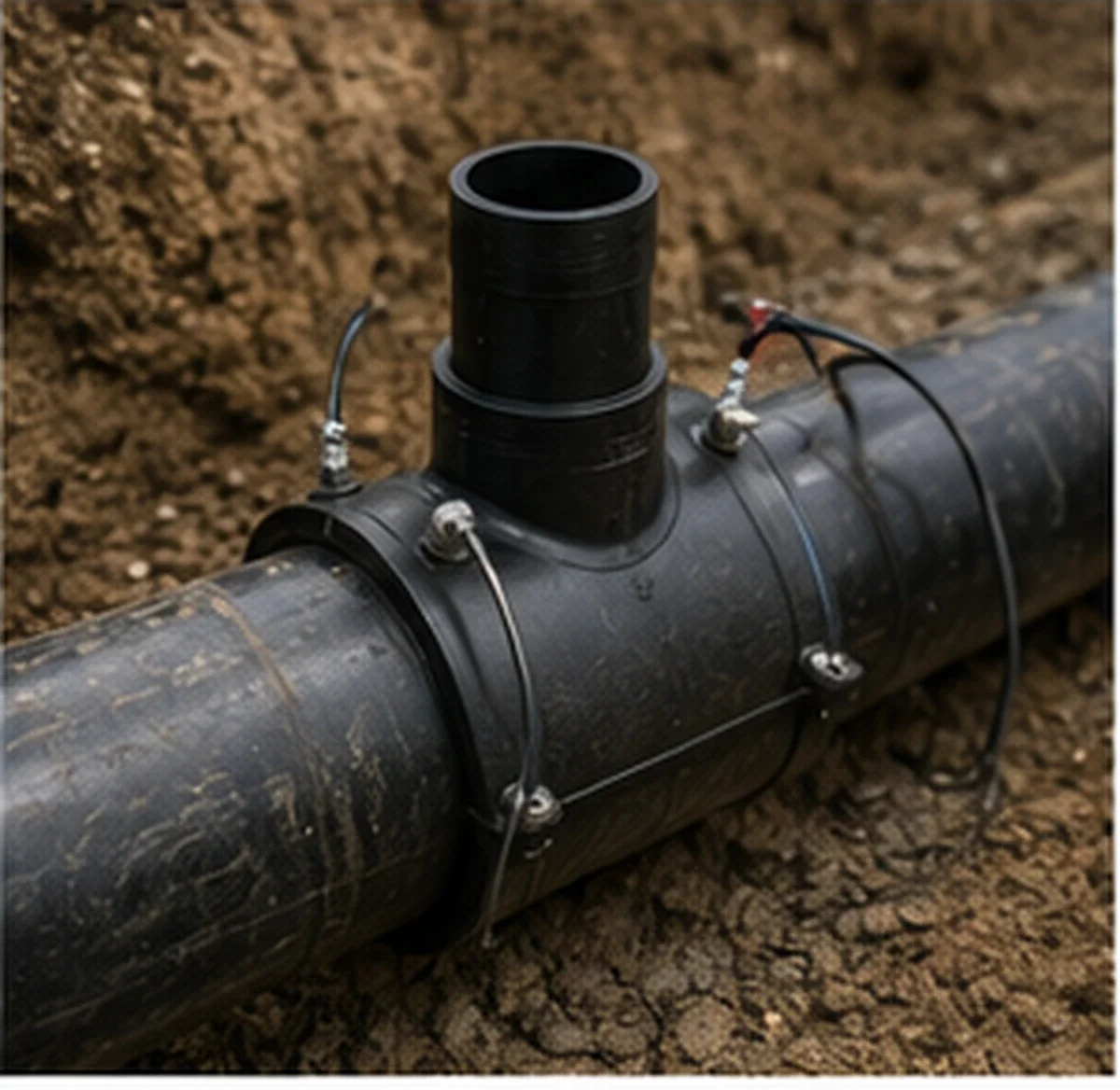
Electrofusion Fittings
Electrofusion fittings contain built-in heating elements.
Controlled electrical energy heats the fitting and pipe surfaces, creating a fused connection.
Common electrofusion fittings include:
- Couplings
- Tees
- Branch saddles
- Tapping fittings
- Repair fittings
Electrofusion can be useful when:
- Working space is limited
- Pipe cannot move easily
- A branch must be added
- A repair is needed
- Butt-fusion equipment cannot fit
Good surface preparation is important. Dirt, moisture, oil, or poor scraping can affect the connection.
Butt-Fusion Fittings
Many HDPE fittings can be joined by butt fusion.
The basic process includes:
- Aligning the pipe and fitting.
- Facing the joining surfaces.
- Heating both surfaces.
- Joining them under controlled pressure.
- Allowing the joint to cool.
The pipe, fitting, equipment, and procedure must be compatible.
Read How to Fuse HDPE Pipes for more detail.
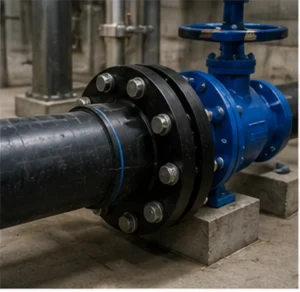
HDPE Flange Adapters
A flange adapter connects HDPE piping to flanged equipment.
Common examples include:
- Valves
- Pumps
- Tanks
- Steel pipe
- Ductile iron pipe
- Process equipment
Flanged connections can also make maintenance easier because equipment may be removed without cutting the HDPE pipe.
Branch Saddles and End Caps
A branch saddle creates an outlet from the side of an existing pipe.
It may use:
- Electrofusion
- Sidewall fusion
- An approved mechanical connection
An end cap closes a pipe end. It may be used for permanent termination, future expansion, fabricated assemblies, or approved testing arrangements.
Both fittings must match the pipe size, pressure, material, and joining method.
Molded vs Fabricated HDPE Fittings
Molded Fittings
Molded fittings are manufactured in standard sizes and shapes.
Common examples include:
- Elbows
- Tees
- Reducers
- Caps
They work well when a project uses common pipe sizes and standard layouts.
Fabricated Fittings
Fabricated fittings are built from HDPE components for a specific design.
Examples include:
- Large elbows
- Large tees
- Wyes
- Manifolds
- Custom reducers
- Spool assemblies
- Special transitions
Fabrication is useful when standard products cannot match the required size, angle, or layout.
WGS Plastic Services provides HDPE and custom plastic fabrication services for industrial and field projects.
When Are Custom HDPE Fittings Needed?
Custom fittings may be useful when:
- Pipe diameter is large
- The angle is unusual
- Several branches are needed
- Space is limited
- Existing equipment has unusual connections
- A special transition is required
- Standard fittings would create too many joints
A custom manifold may replace several tees and short pipe sections, which can simplify the system.
Custom fittings may also be required for dual-containment HDPE pipe, where both the carrier pipe and containment pipe must change direction or connect to equipment.
How to Choose the Right HDPE Pipe Fitting
Use these factors before making a final choice.
1. Confirm Pipe Size
Check:
- Nominal size
- Outside diameter
- Wall thickness
- DR or SDR
Do not choose a fitting from a rough field measurement alone.
2. Check Pressure
The fitting must suit the system’s pressure and temperature requirements.
Two fittings with the same diameter may not have the same pressure capability.
3. Confirm Material Compatibility
Not every polyethylene product is identical.
Make sure the pipe and fitting are suitable for joining and for the material being carried.
4. Choose the Joining Method
Common methods include:
- Butt fusion
- Electrofusion
- Sidewall fusion
- Flanges
- Mechanical connections
Site access can affect the best method.
5. Consider the Application
HDPE systems may carry:
- Water
- Wastewater
- Process water
- Mining slurry
- Industrial liquids
- Chemical solutions
For unusual applications, custom plastic fabrication services may be needed.
6. Check Temperature and Site Conditions
Temperature can affect HDPE system design and installation.
Canadian projects may also involve snow, frozen ground, low temperatures, and remote worksites.
See cold-weather and insulated HDPE pipes for more information.
Quick HDPE Fitting Selection Guide
| Project need | Fitting to consider |
| Change direction | Elbow |
| Create branch | Tee or saddle |
| Change pipe size | Reducer |
| Join sections | Coupling or fusion |
| Tight work area | Electrofusion coupling |
| Connect to valve | Flange adapter |
| Close pipe end | End cap |
| Multiple outlets | Manifold |
| Unusual angle | Fabricated fitting |
| Large diameter | Fabricated fitting |
Are HDPE fittings the same as PVC fittings?
No. HDPE and PVC are different materials with different joining methods.
PVC systems may use solvent cement, gaskets, or mechanical connections. HDPE pressure systems commonly use fusion, electrofusion, flanges, or approved mechanical connections.
See HDPE pipe vs PVC for a full comparison.
Can HDPE fittings be fused directly to pipe?
Yes. Many compatible HDPE fittings can be joined directly using butt fusion, electrofusion, or sidewall fusion.
Always confirm material compatibility and the required joining procedure first.
What fitting connects HDPE pipe to a valve?
A flange adapter is commonly used when connecting HDPE pipe to a flanged valve.
The correct connection depends on pipe size, pressure, valve type, and system design.
Choosing the Right HDPE Fitting
HDPE fittings control how a piping system connects, turns, branches, changes size, and connects to equipment.
Before choosing one, confirm the pipe size, DR or SDR, pressure, material, joining method, temperature, application, and site conditions.
If a standard product cannot meet the layout, custom fabrication may provide a better solution.
For custom fittings, manifolds, large assemblies, or HDPE fusion work, explore custom HDPE fabrication or request a quote from WGS Plastic Services.