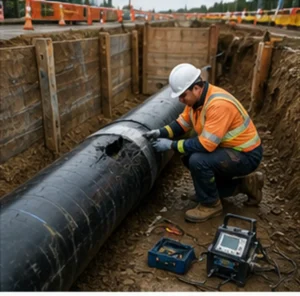
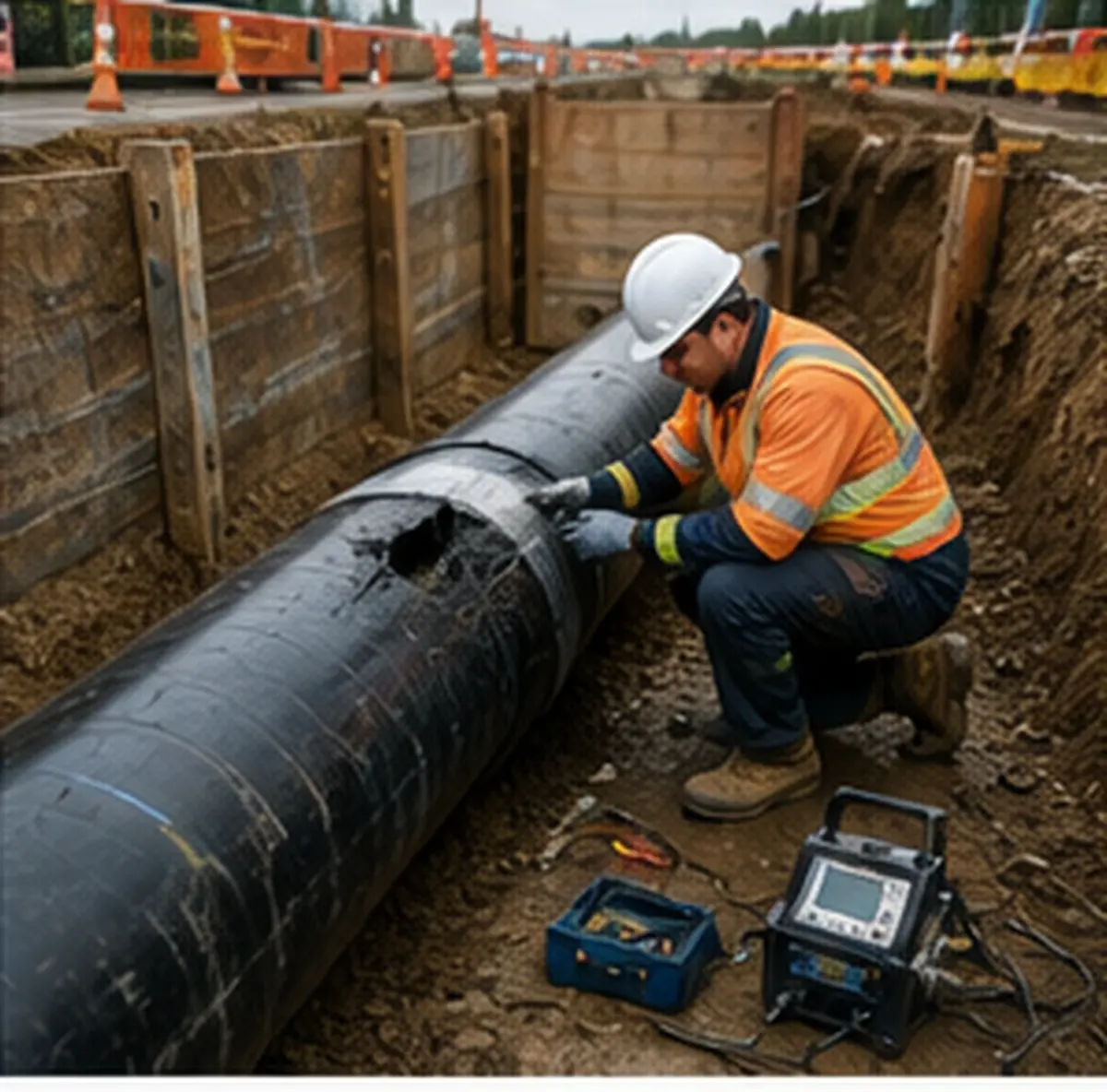
HDPE pipe is strong, flexible, and resistant to corrosion, but it can still be damaged. Excavation equipment, poor support, ground movement, deep scratches, punctures, or problems at a joint can cause leaks or weaken the pipe.
The right repair depends on the size and location of the damage, pipe diameter, pressure, temperature, and what the pipe carries. Small local damage may allow a clamp or electrofusion repair. Crushed, badly split, or heavily deformed pipe will often need the damaged section removed and replaced.
Quick answer: HDPE pipe can often be repaired with electrofusion fittings, mechanical repair clamps, butt fusion, or a replacement spool section. Small punctures may allow a local repair, while major cracks, crushing, or deformation usually require section replacement.
Can HDPE Pipe Be Repaired?
Yes. Many types of HDPE pipe damage can be repaired.
Common methods include:
- Electrofusion repair fittings
- Mechanical repair clamps
- Butt fusion
- Electrofusion couplings
- Replacement spool sections
- Approved mechanical or flanged connections
The repair should be selected after the full damaged area has been inspected.
What Causes HDPE Pipe Damage?
Common causes include:
- Excavator or equipment strikes
- Punctures and holes
- Deep scratches or gouges
- Cracks or splits
- Poor pipe support
- Ground movement
- Damaged fittings or joints
- Poor fusion preparation
- Installation damage
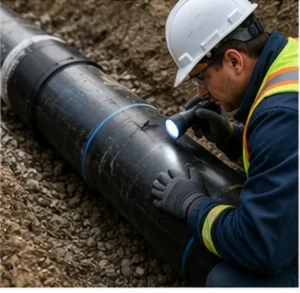
A small visible mark may hide deeper damage. The affected pipe should be exposed far enough to check the full area.
Problems at fused joints may also result from poor surface preparation, contamination, misalignment, or incorrect fusion conditions.
Learn more about HDPE pipe welding and HDPE fusion services.
What Is the Best HDPE Pipe Repair Method?
There is no single method that works for every repair.
| Damage | Possible repair |
| Small puncture | Repair saddle or approved clamp |
| Local leak | Mechanical clamp or fusion repair |
| Damaged joint | Remove and replace the joint |
| Crushed pipe | Cut out and replace section |
| Long crack or split | Section replacement |
| Major equipment damage | Replacement spool |
| Limited pipe movement | Electrofusion or mechanical connection |
| Wet work area | Suitable mechanical repair may be needed |
The final choice must match the pipe size, pressure, service, and project requirements.
Method 1: Electrofusion Repair
Electrofusion fittings contain built-in heating elements. Controlled electrical energy heats the fitting and pipe surfaces to create a fused connection.
Electrofusion may use:
- Couplings
- Repair saddles
- Branch fittings
- Other approved fittings
It can be useful when the pipe is buried, movement is limited, or butt-fusion equipment cannot easily fit into the work area.
Surface preparation is critical. The joining area must be prepared according to the fitting and equipment instructions and protected from dirt, moisture, oil, and other contamination.
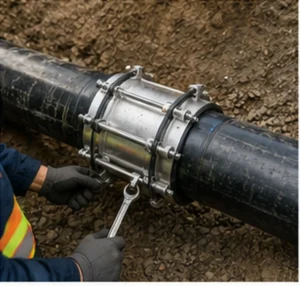
Method 2: Mechanical Repair Clamps
A mechanical repair clamp fits around the pipe and seals a local damaged area.
It may be suitable for:
- Small holes
- Punctures
- Local leaks
- Emergency repairs
- Sites where proper fusion conditions cannot be created
Not every clamp is suitable for permanent use.
The clamp should match:
- Pipe outside diameter
- DR or wall thickness
- Operating pressure
- Temperature
- Material being carried
- Expected pipe movement
Some connections may also require an internal stiffener.
Method 3: Replace the Damaged Section
Large or serious damage often requires the damaged pipe to be removed.
Replacement is commonly considered when the pipe is:
- Crushed
- Badly split
- Deeply gouged
- Deformed
- Damaged over a long section
- Hit hard by construction equipment
A new section, often called a spool piece, is installed between the remaining pipe ends.
It may be connected using butt fusion, electrofusion couplings, mechanical couplings, or flanged connections.
For custom replacement components, see custom HDPE fabrication.
Method 4: Butt Fusion
Butt fusion joins prepared HDPE pipe ends using controlled heat and pressure.
The basic process includes:
- Align the pipe ends.
- Face the joining surfaces.
- Heat the surfaces.
- Bring the ends together.
- Hold the joint through the required cooling period.
Butt fusion works well when there is enough space and pipe movement to position the fusion equipment.
See How to Fuse HDPE Pipes for more detail.
Can You Repair HDPE Pipe With Glue?
Standard PVC solvent cement or general-purpose glue should not be treated as a normal HDPE pipe repair method.
HDPE systems commonly use heat fusion or approved mechanical joining methods.
For industrial, pressure, or critical piping, tape, household epoxy, or makeshift patches should not replace an engineered repair.

How to Repair a Leaking HDPE Pipe
A proper repair normally follows these steps.
1. Make the System Safe
Identify what the pipe carries and follow the site’s isolation, safety, and lockout procedures.
2. Isolate and Depressurize
Shut down the affected section and safely remove pressure before cutting or repairing the pipe.
3. Inspect the Full Damage
Look for cracks, gouges, flattening, deformation, joint movement, and nearby damage.
4. Identify the Pipe
Confirm:
- Pipe size
- Outside diameter
- DR or SDR
- Wall thickness
- Pressure class
- Material
- Operating temperature
See the HDPE pipe dimensions guide if needed.
5. Choose the Repair
Match the repair method to the actual damage and system conditions.
6. Prepare the Work Area
Control water, mud, dirt, snow, ice, and other contamination before fusion work begins.
7. Repair, Inspect, and Test
Follow pipe, fitting, equipment, and project requirements. Inspect and test the repaired system before returning it to service.
When Should HDPE Pipe Be Replaced Instead?
Section replacement is often the better choice when:
- The pipe is badly crushed
- A crack extends over a large area
- Several damage points are present
- The pipe has major deformation
- A fitting and nearby pipe are both damaged
- The remaining pipe condition is uncertain
A larger repair may cost more at first, but repeated leaks and shutdowns can cost more over time.

Can HDPE Pipe Be Repaired in Winter?
Yes, but cold-weather repairs require careful site control.
Snow, ice, moisture, frozen ground, and low temperatures can affect the repair area and fusion process.
Read about winter HDPE fusion best practices and cold-weather HDPE pipe solutions.
Can a hole in HDPE pipe be repaired?
Yes. A small hole may allow an electrofusion repair saddle or approved mechanical clamp. Large damage may require section replacement.
Can you use a repair clamp on HDPE?
Yes, if the clamp is designed for HDPE and matches the pipe diameter, pressure, service, and installation conditions.
Can damaged HDPE pipe be butt fused?
Yes. The damaged section can be removed and new HDPE pipe butt fused into place when there is enough working room.
The Bottom Line
HDPE pipe can often be repaired, but the type and extent of damage should determine the method.
Small local leaks may allow a clamp or electrofusion fitting. Larger cracks, crushing, deformation, or major equipment damage may require the pipe to be cut out and replaced.
For HDPE fusion, replacement sections, or custom components, visit WGS Plastic Services, explore custom HDPE fabrication, or request a quote.